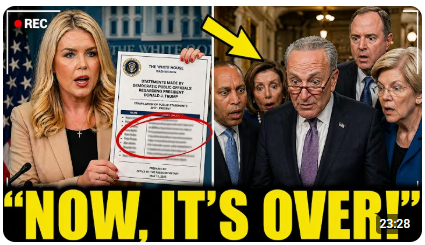
A recent White House press briefing took an unexpected turn when Karoline Leavitt broke from the usual script and delivered a pointed, highly charged message that quickly captured national attention.





The video titled “WATCH THIS… Karoline Leavitt INTERRUPTS Briefing and UNLOADS on Democrats with RECEIPTS!” centers on a moment that disrupted the predictable rhythm of Washington press conferences.
A Routine Briefing Turns Into a Defining Moment
Press briefings in Washington are typically structured and controlled. Reporters ask questions, officials respond, and both sides operate within familiar boundaries.
But in this case, the tone shifted abruptly.
Leavitt paused mid-briefing and began presenting a series of statements—quoting prominent political figures and media personalities. Instead of summarizing or paraphrasing, she cited direct language used in past speeches, interviews, and broadcasts.
This approach immediately changed the atmosphere in the room.
The Strategy: Presenting a Pattern, Not Just Statements
The key element that made the moment stand out wasn’t necessarily the content—it was the delivery.
Many of the statements referenced had already been made publicly. However, hearing them presented consecutively, without interruption or commentary, created a different impact.
Names associated with the remarks included high-profile Democrats such as:
- Hakeem Jeffries
- Elizabeth Warren
- Adam Schiff
By stacking these quotes back-to-back, the presentation shifted from isolated comments to what appeared to be a broader messaging pattern.
The Core Argument: Rhetoric and Its Consequences
Leavitt’s central claim focused on the idea that repeated political language—especially terms like “threat,” “dictator,” or “war”—can influence public perception and potentially contribute to real-world consequences.
The argument raises an important question:
When does political speech cross the line from criticism into something more impactful?
Supporters of this viewpoint argue that repeated messaging can shape beliefs and behavior over time. Critics, however, maintain that such rhetoric is part of normal political discourse and must be understood within context.
Immediate Pushback and Political Framing
The response from Democratic leadership was swift.
Hakeem Jeffries dismissed the presentation as misleading and accused Leavitt of selectively quoting statements without proper context. He also pointed to inflammatory rhetoric and threats coming from the opposing political side.
This exchange reflects a common pattern in modern politics:
- One side highlights statements as evidence of a broader issue
- The other side challenges the framing and context
- The debate shifts from content to credibility
The Role of Media Amplification
The video also emphasizes the influence of media and entertainment in shaping political narratives.
Figures like Jimmy Kimmel and platforms such as The View were cited as examples of how messaging extends beyond political speeches.
When similar themes are echoed across news outlets, talk shows, and social media, they can reinforce a particular narrative—making it more widely accepted or more deeply contested.
A Reflection of Growing Political Tension
Beyond the specific exchange, the moment highlights a broader issue: increasing polarization in American politics.
The video suggests that repeated exposure to strong language from multiple sources has contributed to a more divided public—one where trust in information is often shaped by political alignment rather than shared facts.
This has led to a widening gap between:
- What different groups believe
- How they interpret events
- Who they trust as credible sources
Why This Moment Resonated
What made this press conference stand out wasn’t just the confrontation—it was the format.
Instead of:
- Fragmented media clips
- Edited soundbites
- Commentary-driven narratives
Viewers saw:
- Direct quotes
- Continuous delivery
- Minimal interruption
That shift forced audiences to process the information differently, leading many to reassess familiar political talking points.
The Bigger Takeaway
This moment wasn’t just about one press briefing or one political figure.
It highlighted a larger reality:
In today’s media environment, how information is presented can be just as powerful as the information itself.
Whether one agrees with Leavitt’s approach or not, the incident underscores the importance of:
- Context in political speech
- Accountability in messaging
- Awareness of how repetition shapes perception
Final Thoughts
As political tensions continue to rise, moments like this are likely to become more common.
They don’t just reflect division—they amplify it.
And they leave a lingering question:
Will political discourse move toward clarity and responsibility—or continue escalating through repetition and reaction?
*Disclaimer: In 2026, the fake media is twisting the truth to fit their narrative. As American citizens, we find more truth on YouTube than in the major media outlets. The purpose of ExposingDemocrats.com is to help uncover the truth. Every video ARTICLE is generated using AI with this exact PROMPT: Create an article to explain this video: (copy/paste YouTube link). We do NOT edit or add anything to these video articles.. WE ARE NOT ASSOCIATED WITH YOUTUBE. We are Americans trying to help save our country.