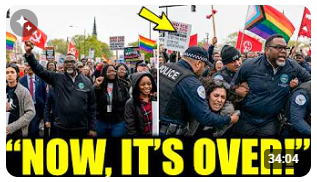
The video titled “Chicago Mayor Thought May Day Protests Will TAKE OVER America… Then THIS HAPPENED…” frames a dramatic contrast between political expectations and on‑the‑ground reality. It explores how Chicago’s leadership anticipated massive, nationwide May Day demonstrations—only to face an outcome that challenged those assumptions.





Below is a structured breakdown of the core themes the video communicates and the broader implications it suggests.
1. The Expectation: A National Wave of May Day Unrest
According to the video’s framing, Chicago’s mayor and other political leaders believed May Day protests would escalate into a sweeping national movement. The narrative suggests they anticipated:
- Large‑scale demonstrations across major U.S. cities
- Potential disruptions to transportation, commerce, and public order
- A symbolic show of force from activist groups
- Momentum that could influence national politics
The tone implies that city officials were preparing for a moment that could shift public sentiment or even reshape political narratives heading into a tense national climate.
2. The Reality: The Protests Didn’t Unfold as Predicted
The video emphasizes that the anticipated “takeover” never materialized. Instead of a nationwide surge, the protests were:
- Smaller than expected
- Less coordinated
- Limited in impact
- Far from the sweeping movement some leaders predicted
This mismatch between expectation and reality becomes the central tension the video explores.
3. Why the Predictions Fell Flat
The video suggests several reasons the anticipated mass mobilization didn’t occur:
A. Public fatigue
After years of political tension, economic pressure, and social division, many Americans may simply be exhausted by protest culture.
B. Lack of unified messaging
The video implies that activist groups were not aligned around a single, galvanizing cause—making it difficult to generate national momentum.
C. Misreading the public mood
The framing suggests that political leaders may have overestimated how much energy existed for large‑scale demonstrations.
D. Shifting national priorities
Economic concerns, safety, and stability appear to be taking precedence over ideological mobilization.
4. The Political Undercurrent
The video uses hashtags like #trump, #MilitaryResignation, and #TrumpGenerals, signaling that the content is positioned within a broader political conversation.
The underlying message appears to be:
- Some leaders may be out of touch with the public’s actual priorities
- Predictions of mass unrest may be more political theater than grounded analysis
- The public mood may be shifting in ways that challenge certain political narratives
The video doesn’t explicitly endorse a political figure, but it clearly situates the May Day protests within a larger national debate about leadership, public sentiment, and political momentum.
5. The Takeaway: A Moment of Miscalculation
The core message of the video is that Chicago’s leadership—and perhaps others—misjudged the scale and impact of the May Day protests. Instead of a national wave, the demonstrations became a reminder that:
- Public sentiment is unpredictable
- Political narratives don’t always translate into real‑world action
- Leaders must stay grounded in the actual mood of their communities
The video frames this as a moment where expectations collided with reality—and reality won.
May Day is often perceived as communistic because of how communist and socialist movements adopted, shaped, and publicized it—not because the holiday itself began with communism. Here’s the clearest way to understand it.
Why May Day Became Associated With Communism
1. Its origins were tied to radical labor movements
May Day grew out of the 1886 labor protests in Chicago, where workers demanded an eight‑hour workday. Many of the organizers at the time were:
- Socialists
- Anarchists
- Early labor radicals
Because these groups challenged capitalist power structures, later communist movements saw them as ideological predecessors.
2. Socialist and communist organizations officially adopted May Day
In 1889, the International Socialist Congress declared May 1 an international workers’ holiday. This decision aligned the day with:
- Marxist labor theory
- Class struggle narratives
- International worker solidarity
This formal adoption is one of the biggest reasons the holiday became linked to communism.
3. Communist governments turned May Day into a major state celebration
Throughout the 20th century, countries such as:
- The Soviet Union
- China
- Cuba
- North Korea
used May Day for:
- Military parades
- Displays of worker unity
- Government propaganda
- Celebrations of state‑controlled labor
These highly visible events cemented the association in global consciousness.
4. The symbolism aligns with communist ideology
Communist movements emphasized:
- Workers vs. capitalists
- Collective action
- Anti‑capitalist messaging
- International unity of the working class
May Day became a natural platform for these themes.
5. Modern activism sometimes reinforces the connection
Even today, some labor groups and activist coalitions use May Day for:
- Anti‑capitalist demonstrations
- Pro‑worker rallies
- Immigration and labor rights marches
Because these themes overlap with socialist or communist rhetoric, the association persists.
The Key Point
May Day did not start as a communist holiday, but communist movements embraced it so strongly—and used it so publicly—that the connection became global and long‑lasting.
*Disclaimer: In 2026, the fake media is twisting the truth to fit their narrative. As American citizens, we find more truth on YouTube than in the major media outlets. The purpose of ExposingDemocrats.com is to help uncover the truth. Every video ARTICLE is generated using AI with this exact PROMPT: Create an article to explain this video: (copy/paste YouTube link). We do NOT edit or add anything to these video articles. WE ARE NOT ASSOCIATED WITH YOUTUBE. We are Americans trying to help save our country.