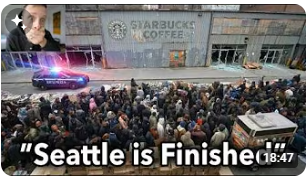
A growing narrative is emerging in major U.S. cities: rising crime, shifting policies, and businesses quietly pulling out. The video titled “Seattle LEGALIZES Looting… Then Starbucks BOARDS UP and Leaves FOREVER” dives headfirst into that tension—using Seattle as a case study for what happens when public safety, politics, and economics collide.





This isn’t just about one city. It’s about a pattern that’s starting to show up across urban America.
The Core Claim: “Legalized Looting”
The video frames Seattle’s approach to crime as overly lenient—suggesting that policy decisions and enforcement gaps have created an environment where theft is rarely punished.
Now, let’s be real:
No city has literally legalized looting. That’s a headline-style exaggeration.
But the underlying concern is real:
- Retail theft has increased in many urban areas
- Prosecutorial policies in some cities prioritize non-violent crimes less aggressively
- Police staffing shortages have reduced enforcement capacity
What people are reacting to isn’t “legal looting”—it’s the perception of low consequences.
And perception alone can change behavior.
Starbucks Closing Locations: A Signal, Not an Accident
One of the biggest talking points in the video is Starbucks shutting down locations in Seattle.
That’s not random.
Major corporations don’t close profitable stores unless something is wrong. When they do, it usually points to:
- Safety concerns for employees
- High theft rates (a.k.a. “shrink”)
- Declining foot traffic due to crime or instability
Seattle is especially symbolic because it’s Starbucks’ home base. When even a hometown brand pulls back, it sends a message:
Something has shifted.
The Bigger Pattern Across Cities
Seattle isn’t alone.
Cities like San Francisco, Portland, and Chicago have faced similar issues:
- Retailers locking up basic goods
- Stores closing in high-crime zones
- Public frustration over safety and accountability
This is where the conversation gets uncomfortable—but necessary.
Why This Is Happening
The video leans heavily toward one explanation (policy failure), but the full picture is more complex.
Several factors are colliding at once:
1. Policy Shifts
Some cities have moved toward:
- Reduced prosecution for low-level offenses
- Bail reform
- Police budget reductions or reallocations
2. Economic Pressure
Inflation, inequality, and post-pandemic instability have increased desperation in some communities.
3. Policing Challenges
Departments are dealing with:
- Staffing shortages
- Lower morale
- Increased scrutiny
4. Cultural Shift
There’s a growing divide in how people view:
- Law enforcement
- Personal responsibility vs systemic issues
The Real Consequence: Business Flight
Here’s the part most people miss:
When businesses leave, it doesn’t just hurt corporations—it hits communities.
Closures lead to:
- Job losses
- Fewer local services
- Reduced tax revenue
- Declining neighborhood stability
It becomes a cycle:
- Crime rises
- Businesses leave
- Economic opportunity shrinks
- Crime rises further
That’s the downward spiral cities are trying to avoid.
Media Framing vs Reality
The video uses strong, emotional framing—because that gets attention.
But here’s the truth:
- Crime issues are real
- Policy debates are valid
- But extreme language can oversimplify complex problems
If you only listen to headlines (on either side), you miss the nuance—and the solutions.
What Needs to Happen Next
If cities want to reverse this trend, they’ll need balance—not extremes.
That means:
- Enforcing laws consistently (especially repeat offenses)
- Supporting businesses so they can operate safely
- Addressing root causes like addiction, homelessness, and poverty
- Rebuilding trust between communities and law enforcement
No single fix will solve this.
But ignoring the problem—or exaggerating it—won’t help either.
Final Takeaway
The video taps into a real frustration people are feeling:
When everyday rules stop being enforced, everything starts to feel unstable.
Seattle isn’t collapsing—but it is at a crossroads.
And what happens there will likely shape how other cities respond moving forward.
*Disclaimer: In 2026, the fake media is twisting the truth to fit their narrative. As American citizens, we find more truth on YouTube than in the major media outlets. The purpose of ExposingDemocrats.com is to help uncover the truth. Every video ARTICLE is generated using AI with this exact PROMPT: Create an article to explain this video: (copy/paste YouTube link). We do NOT edit or add anything to these video articles. WE ARE NOT ASSOCIATED WITH YOUTUBE. We are Americans trying to help save our country.