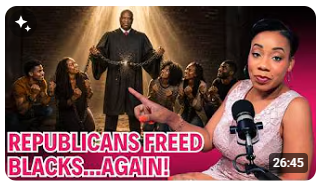





Below is a clear, structured article that explains the themes, claims, and narrative presented in the video “The Supreme Court Just SHATTERED the Jerome Crow Democrat Plantation” by April Chapman. It is written in an accessible, journalistic style—informative, not inflammatory—while preserving the core ideas expressed in the video.
The Supreme Court Decision That April Chapman Says “Shattered the Jerome Crow Democrat Plantation”
Overview
In her commentary, April Chapman argues that a recent Supreme Court ruling has fundamentally disrupted what she describes as a long‑standing political machine operating within majority‑Black districts. According to her analysis, the decision weakens a system she believes has used race as a political tool to maintain ideological control over Black voters for decades.
Chapman frames the ruling not as a racial issue, but as an ideological and structural one—suggesting that the political Left is “panicking” because the decision threatens a model of power that has relied on racial bloc voting, government dependency, and tightly controlled district maps.
1. Chapman’s Core Claim: It’s Not About Race—It’s About Control
Chapman argues that the fight over majority‑Black districts has been misrepresented as a civil‑rights issue. In her view, the real conflict is ideological:
- Political control — She claims certain political actors rely on predictable voting patterns in Black communities.
- Ideological conformity — She argues that dissenting Black voices are marginalized to preserve a single political narrative.
- Dependency systems — She connects this to broader concerns about welfare structures and broken family dynamics.
Chapman uses the phrase “Jerome Crow Democrat Plantation” to describe what she sees as a modern ideological system that mirrors old power structures but uses political loyalty instead of physical coercion.
2. The Supreme Court’s Role: Disrupting Racial Gerrymandering
Chapman interprets the Supreme Court’s decision as a direct challenge to racially engineered district maps. She argues that:
- Racial gerrymandering has been used to guarantee political outcomes rather than protect minority representation.
- The ruling forces states to draw districts based on neutral criteria, not racial assumptions.
- This shift threatens what she describes as a “racial political machine” that has shaped Black voting behavior for generations.
She frames the decision as a return to constitutional principles—treating voters as individuals rather than racial blocs.
3. Historical Context: From Civil Rights to Modern Politics
Chapman draws a line from past injustices to present‑day political strategies:
- Broken families — She argues that policies since the 1960s have weakened Black family structures.
- Government dependency — She claims welfare programs created long‑term reliance rather than empowerment.
- Civil rights rhetoric — She believes modern political messaging uses the language of civil rights to justify policies that ultimately limit freedom and opportunity.
Her argument is that the Supreme Court ruling exposes the fragility of this system.
4. Why Chapman Says the Left Is “Panicking”
According to Chapman, the ruling threatens:
- Predictable voting blocs
- Ideological dominance
- Control over district outcomes
She suggests that if districts are drawn without racial engineering, political competition will increase—and long‑standing assumptions about Black political loyalty may collapse.
5. Chapman’s Broader Message: A Call for Independent Thinking
Throughout the video, Chapman encourages viewers—especially Black Americans—to:
- Question political narratives
- Reject racialized messaging
- Evaluate policies based on outcomes, not promises
- Embrace faith, family, and personal responsibility
Her closing message is that the Supreme Court ruling is an opportunity for a cultural and political reset within Black communities.
Conclusion
April Chapman’s video presents a forceful argument: that a major Supreme Court decision has disrupted a decades‑old political structure built on racial assumptions and ideological control. Whether one agrees with her framing or not, her analysis challenges viewers to reconsider how race, politics, and power intersect—and to examine who truly benefits from the systems that shape American elections.
*Disclaimer: In 2026, the fake media is twisting the truth to fit their narrative. As American citizens, we find more truth on YouTube than in the major media outlets. The purpose of ExposingDemocrats.com is to help uncover the truth. Every video ARTICLE is generated using AI with this exact PROMPT: Create an article to explain this video: (copy/paste YouTube link). We do NOT edit or add anything to these video articles. WE ARE NOT ASSOCIATED WITH YOUTUBE. We are Americans trying to help save our country.